


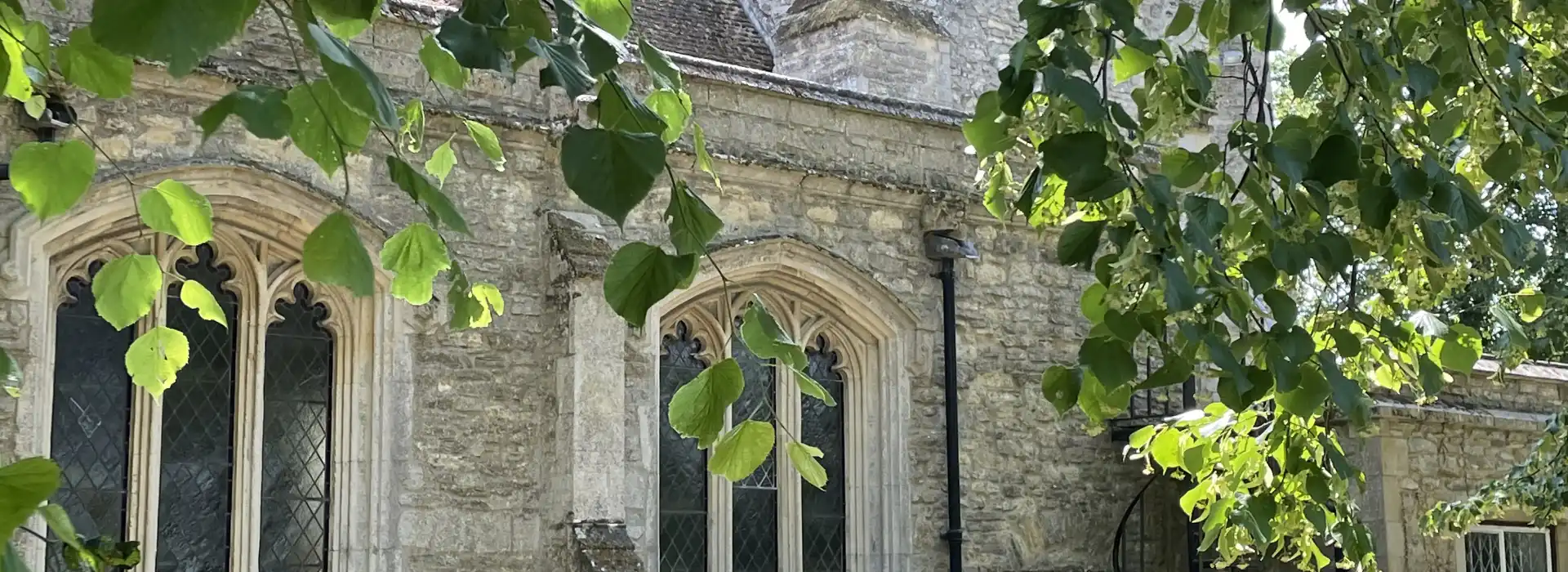
Traces of the original small church building can still be seen today. Most notable is the large, rounded arch between the nave and chancel, heavily restored and often considered Norman, though its lack of typical decoration has led some to suggest it might be Saxon. The main entrance arch, doorway, and a blocked window nearby are also remnants of the early Norman structure.
Significant alterations were made in the 13th century. Inside the base of the 13th-century tower, a blocked splayed window and doorway are visible, along with part of the original Norman west wall.
By the late 14th century, following the Black Death and as the population and wealth increased, churches were expanded and improved. The chancel was rebuilt and enlarged. A plain, chamfered priest’s door with a painted head was added to the south wall, still in use today. A large east window in decorated Gothic style with reticulated tracery was installed. Inside, the sedilia—a stone seat under the south window—was built for clergy use during mass.
From the same period, a heavy six-planked chest reinforced with iron, likely used to store vestments and documents, survives and is now kept in the vestry. Originally equipped with three locks, it ensured that only the priest and two churchwardens together could open it. The current church registers are still stored there.
In the 15th century, the church underwent further expansion. A south aisle was added, and the nave roof raised. A piscina with a cinquefoiled head marks the presence of an altar in this aisle. William Boteler endowed a chantry chapel here, dedicated to Saint William, to fund prayers and masses for his family’s souls.
The upper tower was built to house bells, and bequests made between 1520 and 1541 contributed to their upkeep. The church’s fine octagonal font also dates from the 15th century. Set on a pedestal with rectangular panels bearing plain shields, each side of the bowl is decorated with carved trefoils, quatrefoils, and daggers. Some panels feature a foliate boss, one with a central rose. The basin, lead-lined with a drain, reflects the requirement from the 13th century that fonts be covered to protect holy water—blessed on Easter—from dirt or misuse in superstitious rituals. The font stands near the south entrance, serving as a reminder of baptismal vows.
The church porch served both religious and secular purposes and provided shelter. It retains an original stone bench on the east side and a barrel roof with wooden bosses carved with vine flowers. A “scratch” or “mass” dial on the left stonework near the entrance once marked service times. Also carved into the stone are apotropaic symbols—ritual protection marks like crosses, daisy wheels, and interlaced Vs (for Virgo Virginum, invoking the Virgin Mary)—meant to guard against evil. These markings mostly date from the 16th to 18th centuries.
Above the porch, the parvis room likely served as lodging for visiting monks or a sanctuary. Unlike similar rooms in other medieval churches, such as Bromham, there’s no evidence it was used as a school or library.
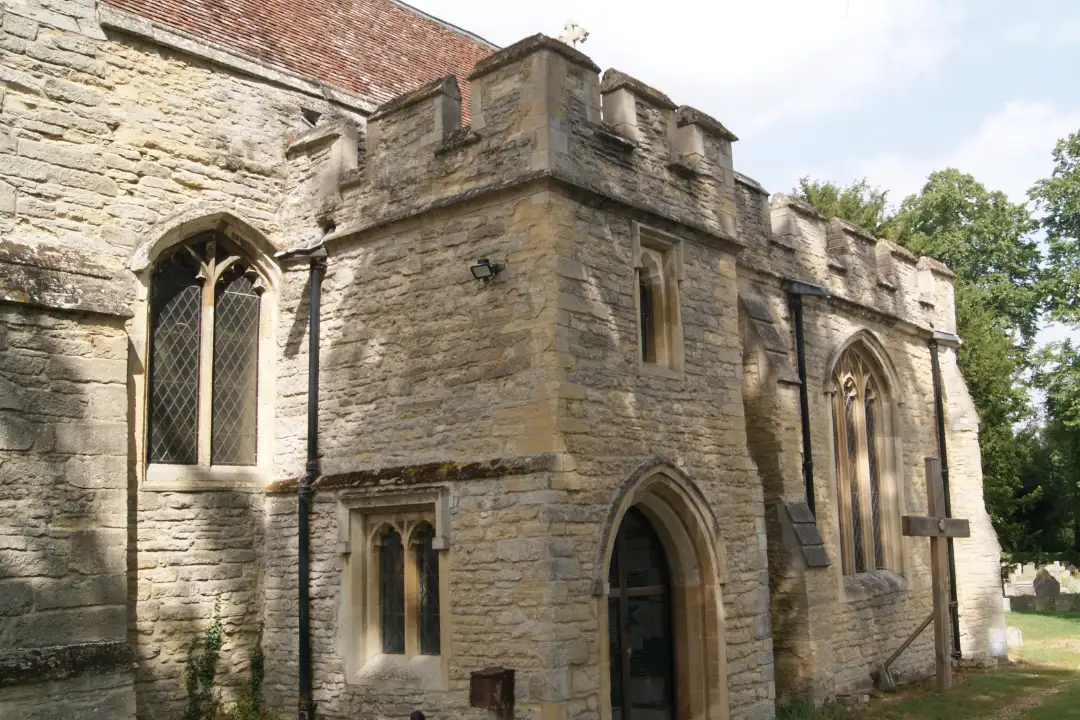
The parvis above the church porch
A contract from 16 December 1522 details the construction of the north aisle, commissioned by Sir William Boteler and executed by John Laverock, a freemason from St Albans. The perpendicular arcade separating the nave and aisle has two bays with a central column made of clustered semicircular shafts, topped with semi-octagonal capitals and decorative plinths. At the tops are carvings honouring the aisle’s benefactors: the Boteler coat of arms, a dove with a scroll to the east, and a wyvern—a dragon-like creature—on the west, the crest of the Dyves family of Bromham, previous holders of the church’s advowson and rectory and likely financial contributors.
Two squints—angled openings—were cut into the walls flanking the chancel arch to allow views of the main altar from the new aisles.
At the east end of the north aisle, three small brass figures set into a Purbeck marble slab commemorate the Faldo family—William, Agnes, and John—dated to around 1490. The figures are shown in prayer, with William and John in long robes, bare-headed, and Agnes in a V-necked gown with a butterfly headdress. An inscription reads “Orate p. aiab'”, short for “Orate pro animabus”, Latin for “Pray for the souls.” Nearby, a separate slab bears two female effigies in shrouds, undated but likely from around 1530.
Huge thanks to Katherine Fricker, Mary McKeown and Diana Toyn for the exquisitely written “The Village of Biddenham through the Ages” book and to Mary for granting permission to use fragments in the writing of this section.