


When entering the churchyard through the south gates, the eye is immediately drawn to two impressive Cedars of Lebanon. One branch arches over the path, partially obscuring the church tower. A handwritten note in the baptism register (1813–1875) records that Vicar Henry Wood planted the trees on 22 December 1875. They were grown from seeds taken from a cone brought back from Lebanon by his brother-in-law, Admiral Gardner CB, and were six years old at planting.
The churchyard is enclosed by a stone wall lined with lime trees on all sides. Three yew trees stand in the north-east corner. In July 2008, a new northern extension to the churchyard, donated by the Pile family, was consecrated by Bishop Richard Inwood. An earlier extension of 30 yards was made in 1897 with land donated by E. R. Wingfield. That same year, a fire destroyed nearby cottages and a farm east of the church. One cottage belonged to the West family, and their grave now occupies the former site of their fireplace.
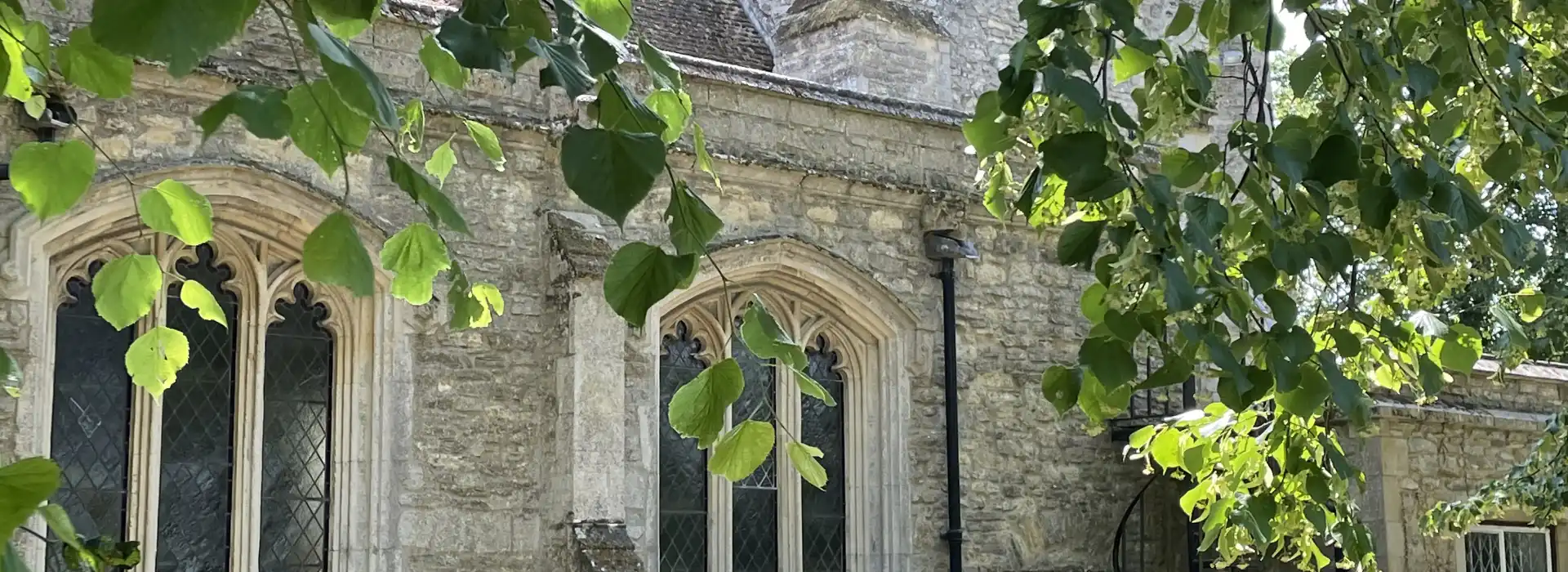
Taking the right-hand path after entering gives a clear view of the church’s exterior. To the left stands the base of an old preaching cross. The tower, porch, and south aisle are castellated, while the spire is wooden, lead-covered, and topped with a gilded cockerel weather vane.
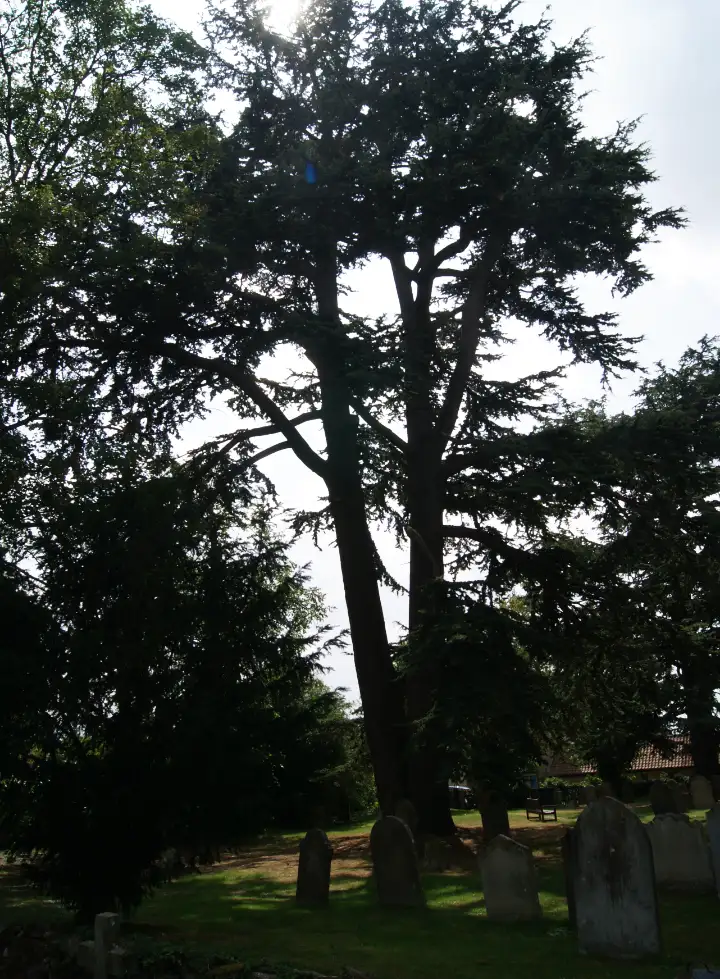
One of the church’s magnificent cedars of Lebanon

The clay-tiled roofs feature a stone cross at the nave’s end. The church clock was made by William Emmerton of Wootton and installed in 1787, the same year he recast the bells. This work was funded by Captain John Brooks, RN, of Ford End Manor.
A stone plaque on the east side of the tower may commemorate Robert Leader, a carpenter in the village in 1710. A blocked south doorway, once used for bell ringing, is visible. The tower’s original 15th-century buttresses were later refaced. A plaque on the northwest buttress honours John Davis (1812).
Among the oldest legible gravestones are those of Thomas Clark (1707) and James Harris (1708), whose epitaph reads: “Prepare in youth, no time delay / For I in my prime was cald away.” Nearby are more 18th-century markers, such as that of Thomas Adkines (1715): “In death how sudding is thy stroke / which no meer man can ere revoke.”
At least eight parish incumbents are buried here. Notable 20th-century tombstones include two Celtic crosses: one for Edith Alice Duigan (1912) by architect C.E. Mallows, and one for Charles Edward Mallows, designed by Edward Landseer Griggs. A striking 1851 obelisk in the north-east corner commemorates John McBride Missing, aged 29, and his father, Rev. John Missing M.A., former curate. Curiously, despite the memorial’s claim, Rev. Missing does not appear in the church records.
Huge thanks to Katherine Fricker, Mary McKeown and Diana Toyn for the exquisitely written “The Village of Biddenham through the Ages” book and to Mary for granting permission to use fragments in the writing of this section.