

A history of St James
There has been a church in Biddenham since at least the 11th or 12th centuries. After the disappearance of a probably wooden Saxon church, the stone structure consisted of an aisleless nave with a much restored Norman arch and small chancel beyond. Thereafter, as money and patrons were found, the church was enlarged. The lower part of the tower is from 13th century; the upper part was added in 15th century.
The next stage was the enlargement of the Chancel in the 14th century, and there are vestiges of original stonework still visible. What was probably originally a chapel was built on the south side, which opened into the church and formed an aisle, backing onto the 15th century porch.
Two wealthy local families, the Botelers and the Dyves, paid for the south aisle in 1522. Nevertheless, the church must have been crowded and awkward to work in with parts of this aisle divided from the rest by a screen to act as a vestry. This was only remedied in 1974 with the construction of the new vestry. The various windows in the church reflect the stages of building from the 14th to 16th centuries, although most have been restored. There are traces of earlier windows in the stonework.
There is still much evidence of the history and development of the church in the furnishings inside.
A list of incumbents dating back to 1231 can be found at the foot of the tower. The font, just inside the entrance door, is from the 15th century and, of course, is still in use today. There are numerous memorials on the walls, some with very touching inscriptions, several from the 19th century, with older former floor memorials in the vestry. The most striking memorial is on the wall near the altar of the Boteler family, William having died in 1601 and his wife twenty years later.
The south aisle is divided from the nave by a Jacobean screen, which was originally in the north aisle. Some splendid 17th century brasses are to be found in the north aisle. Biddenham as a village was much affected by the Arts and Crafts movement at the end of the 19th century, with several houses being of significant architectural importance. Craftsmen from this movement also adorned the church: the East window is from the factory of the most influential stained-glass maker of the period and the pulpit, the lectern and the vicar’s stall are all in this style.
Additions in the 20th century include a memorial window for engineer Sir John Howard, the roll of honour for those killed in the two world wars and the fine Millennium window, consecrated in 2000, depicting scenes from village life. In this period also the bells from 1767 were added to and rehung.
The church is always open to visitors and as you enter a booklet can be purchased which describes the church in more detail, both inside and out.
The ancient books owned by the church
St James Church owns quite a number of ancient books, notably a leather-bound Bible published in 1739 and a leather-bound prayer book published in 1748.
A Bible in English
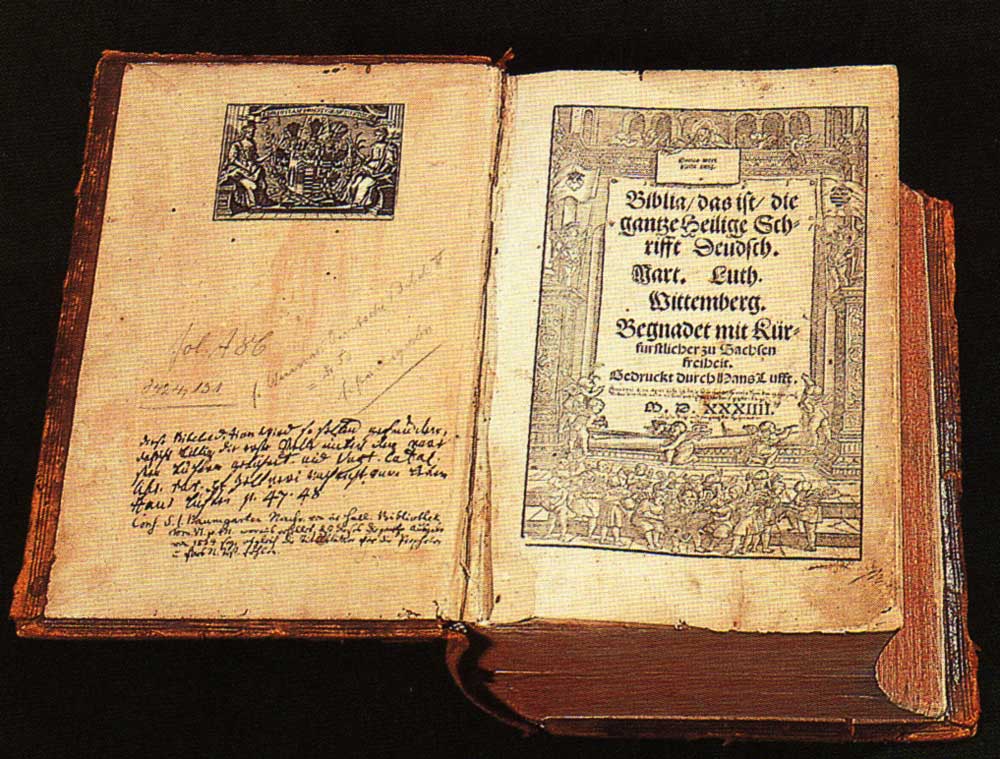
This Bible is printed in English, which might not seem anything to comment on, but it was only just over a century before 1739 that it was possible to find a Bible in English, and these Bibles would only be useable by very few people.
Some of the history of the Bible in English can be traced back to 1380, when against a lot of opposition a group influenced by John Wycliffe translated the Bible into English. This version was difficult to understand and as the printing press had not been invented it was not printed and distributed widely.
In 1524 a translation of the Bible into English created by William Tyndale was printed on a press, but a law was passed making it a capital offence to read this Bible and the archbishops burned every copy they found.
In 1534 the English church broke from the Catholic Church and in 1611 the Authorised Version of the bible was published in English.
So, just over 100 years before this bible of ours was published, people in England were allowed for the first time to read the bible for themselves if they knew how to read, though usually the only Bible around would be found in a church and belong to the priest who himself might not be able to read.
Social conditions in 1739
Around this time, England was emerging from a period of poor harvests and widespread hunger, with nutrition gradually improving. Life expectancy averaged around 31 years. The early stages of the Industrial Revolution were beginning, arriving sooner in England—according to French historians—partly due to higher literacy rates compared to the rest of Europe. French historians attribute this at least in part to the fact that in England the protestant priest encouraged the population to read the Bible and Bible knowledge was promoted. The conditions in the factories in England were very bad. Soon after our Bible was published, in 1791 the French Revolution took place, triggered by terrible social conditions in that country. The king was executed and there was a reign of terror.
Life in England after 1739
From the 1750s nutrition was improving in England because of an increase in agricultural output and because of this health was improving. At this time too John Wesley, his brothers and George Whitfield were preaching all over England, travelling enormous distances, usually on horseback. They had an enormous impact on the belief and behaviour of people all over the country.
They preached that employees should work well, even when their masters were not watching (Colossians 3.22), that employees must respect their masters (Timothy 6.1) and that they must work cheerfully as unto God (Ephesians 6.7). They also preached that employers must stop threatening their employees (Ephesians 6.9) and that they must treat their employees justly and fairly (Colossians 4.1).
According to their teaching, employees and masters were no different in God’s eyes (Colossians 3.11) and both should copy Jesus, who, although he was Lord of everything, took on himself the position of servant (Philippians 2.6). It was thought that this preaching of the way that God requires masters and employees to behave and the call to live like Jesus as described in the Bible had a great influence on the general thinking among working people of the time.
A prayer book
As well as the Bible, the people had the Prayer Book like our copy published in 1748. If one looks at just one prayer used in many churches each week at communion, the prayer of humble access, one can see again something that lead to public peace. The prayer is all about how we can come before God and reads thus:
We do not presume to come to this thy Table, O merciful Lord, trusting in our own righteousness, but in thy manifold and great mercies. We are not worthy so much as to gather up the crumbs under thy Table. But thou art the same Lord, whose property is always to have mercy: Grant us therefore, gracious Lord, so to eat the flesh of thy dear Son Jesus Christ, and to drink his blood, that our sinful bodies may be made clean by his body, and our souls washed through his most precious blood, and that we may evermore dwell in him, and he in us. Amen.
The Prayer of Humble Access
It makes clear that the only access to God is not in our own righteousness, but through the undeserved mercy of God shown at the cross of Jesus. It speaks of our failure to live to God’s standards, of God’s mercy and of our need for repentance, cleansing and strengthening before we have any worth or righteousness. Not really a revolutionary document.
This was true just as much for those who had power and wealth as well as for the powerless, and encourages everybody to come to God in humility and then to react to each other as equals. So to some degree, these books and the work of preachers who explained their message changed the history of our country and was one factor among others that led to change without violence.
A new painting in the church
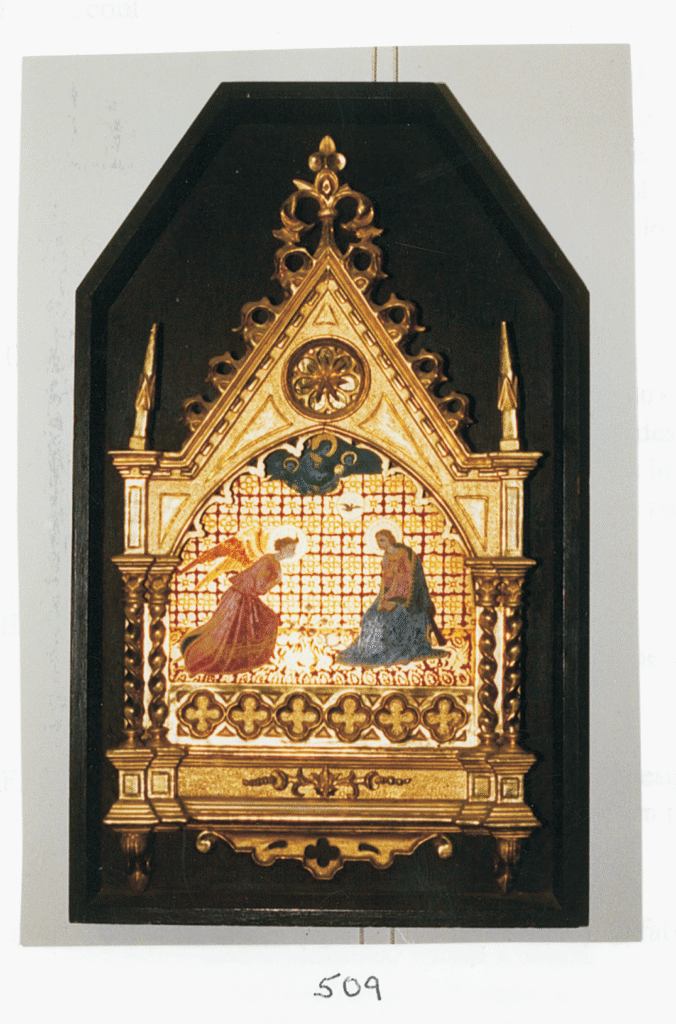
For many years there has been a beautiful painting of “The Annunciation” in the vestry. This painting is a Victorian copy of one painted by Fra Angelico done in the 15th century and currently found in the monastery of saint Marco in Florence. The diocese has allowed us to move this into the church so more people can see it.
The painting shows the angel Gabriel appearing to Mary, a teenage girl living in Palestine, and telling her that she would bear the Son of God, God himself come down to earth. Mary was not yet married to Joseph, and this could have led to the collapse of her marriage or even to her being accused of adultery and being stoned. Mary nonetheless agreed to God’s command. This led to her having her baby in a cowshed in Bethlehem, an odd place for God to choose to come into His world.
Soon afterwards the life of this family was threatened, and they became asylum seekers in Egypt, a topical touch to this story. When they came back to Israel, her son became a homeless itinerant preacher and was finally executed as a criminal, thereby paying the price for our sins. Only later did he rise from the dead, and even after that the people of God were severely persecuted by the Roman authorities. All this came out of the faithful obedience of a teenage girl.
Some people say that faith in God and obedience to Him is a crutch. It certainly wasn’t for this young girl or for many other Christians who faithfully follow God’s will.
The painting is on the east wall of the body of the church in the prayer corner. I would invite you to go and look at it and meditate on what God may require of His followers when He asks us to follow Him as Mary did. Christianity is not for wimps, but for real men and women who are willing to commit themselves to The Kingdom of God wherever it leads.