


Stained Glass Windows of St James’s Church, Biddenham
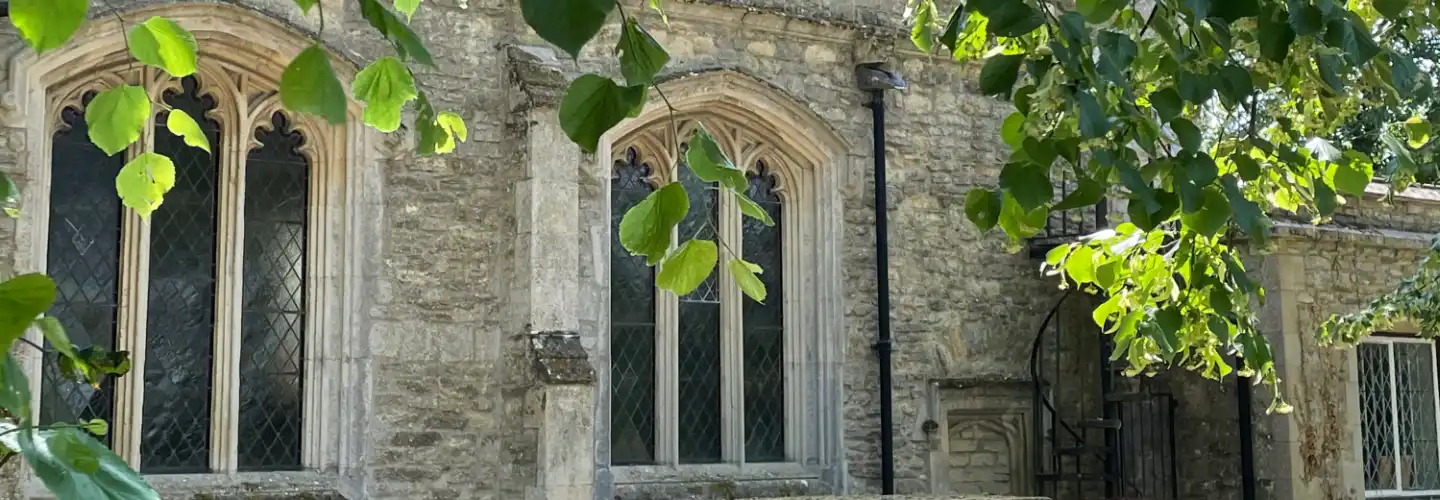
Among the most visually striking features of St James’s Church are its stained glass windows, each rich in symbolism and dedicated to individuals who served the church or community with distinction.
The Charles Howard Memorial Window
The Charles Howard Memorial Window, installed in 1897, dominates the east end of the church. Donated by his grandson, Sir John Howard, it commemorates Charles Howard, former churchwarden and chairman of Bedfordshire County Council, who died in 1895. Designed by Charles Kempe, a master of Victorian stained glass, the window reflects his admiration for 15th-century medieval glasswork.
Using vivid green, blue, and ruby hues, and exquisitely detailed floral motifs, Kempe created a powerful spiritual tableau. At its centre, Christ the King sits crowned and enthroned. On His left is St Peter, with key and book, accompanied by the Archangel Michael; on His right, St Paul in a red robe holds an open book inscribed with “Caritas Xti urget nos” (2 Corinthians 5:14), which translates as “For the love of Christ constraineth us; because we thus judge, that if one died for all, then were all dead”. Behind Paul is St James of Compostela, staff and scallop-shell hat in hand, with the inscription “Te gloriosus apostolorum” (The glorious choir of the Apostles) above him.
The Douglas Carey Memorial Window
The Douglas Carey Memorial Window, located at the east end of the south aisle, was dedicated in 1949 to the memory of Douglas Falkland Carey, who served as vicar from 1936 to 1946. The window portrays St Michael on the left, wearing golden armour beneath a green cloak and holding a red shield and sword. Above him, balance scales symbolise divine judgment. Opposite is St Barnabas, dressed in green with a blue and gold cloak, holding a staff and book bearing the words “A good man and full of holy spirit and faith.” Their names are inscribed below in scrolls of plain glass.
The Sir John and Lady Howard Thanksgiving Window
The Sir John and Lady Howard Thanksgiving Window, placed on the east side of the chancel in 1969, marks the restoration of the chancel and their gratitude. The window features symbols of the two saints: St John’s chalice and St James’s martyr’s sword. On the left stands St John the Evangelist, haloed in red and orange, wearing multicoloured robes and accompanied by a vision of the Transfiguration.
Opposite, St James the Great—barefoot, with staff in hand—stands over the scene of Christ’s Agony in the Garden. The golden figure of Christ is shown praying, with two disciples asleep beneath Him. This James, son of Zebedee, was a fisherman turned apostle, later martyred by Herod Agrippa, making him the only apostle whose death is recorded in the Bible (Acts 12:2). His feast day is 25 July.
Sir John Howard (1901–1986) served as a devoted churchwarden at St James’s from 1957 to 1984, playing a key role in the church’s restoration and maintaining its spiritual life.
The Benedicite Window
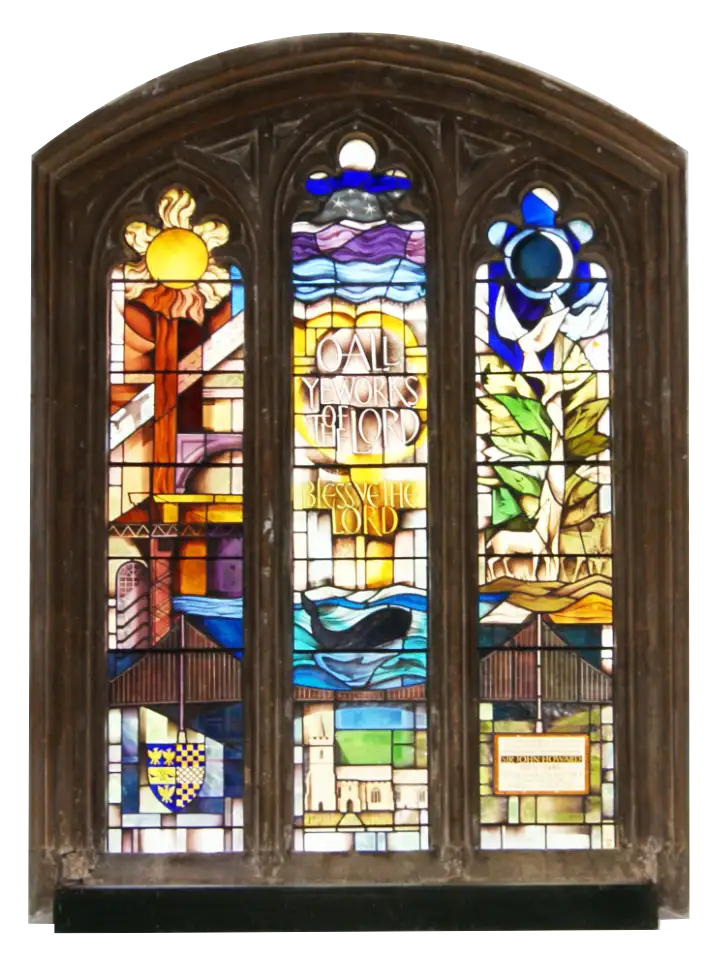
The Benedicite Window, also known as the John Howard Window, was added in 1990 and honours Sir John Howard. The window celebrates both his professional life and personal passions. A bridge spanning all three lights symbolises his work as a civil engineer on the Humber and Severn bridges.
The left panel highlights his engineering achievements, while the right reflects his love of the natural world, featuring trees, deer, birds, and a butterfly. At the bottom, the arms of the Harpur Trust, which he chaired, appear. The church itself is pictured in the central panel, with the verse “O all ye works of the Lord bless ye the Lord” inscribed above waves and a whale.
“Benedicite” is a Latin word meaning “Bless ye the Lord.” It comes from an ancient hymn of praise in which all parts of creation—sun, moon, stars, earth, animals, and people—are called to glorify God. Traditionally used in Christian worship, especially in the Church of England, the Benedicite celebrates the beauty and unity of creation in joyful thanksgiving to its Creator.
The Millennium Window
Lastly, the Millennium Window, located at the west end of the bell tower, celebrates village life at the turn of the third millennium. A river—symbolising the western boundary of Biddenham—flows from top to bottom, passing through the date 2000 to represent the flow of time. Seasonal vignettes portray village scenes: autumn at the war memorial and cedar tree, a wintery church view, spring at Post Office Row, and a summer cricket match. At the top, symbols of St James—the crook and scallop shell—anchor the scene. The inscription reads “God is our God” (Psalm 48:14).
Huge thanks to Katherine Fricker, Mary McKeown and Diana Toyn for the exquisitely written “The Village of Biddenham through the Ages” book and to Mary for granting permission to use fragments in the writing of this section.